


How does it work?
Centuries of astronomy, on a small computer inside every MOON.

Hipparchus · c. 190–120 BC
He measured the Moon’s cycles and its distance from Earth, using eclipses.
Ptolemy · c. 100–170
He built a model that could predict where the Moon would be.
Galileo Galilei · 1564–1642
With a telescope he saw that the Moon is a world, with mountains and shadows.
Jean Meeus · born 1928
He turned two thousand years of this into formulas a computer can run.
The code
We rewrote his algorithms in code.
We have written Jean Meeus’ algorithms again, as code made for MOON. It runs inside the piece, with no connection, and calculates the Moon on its own for the next 100 years.
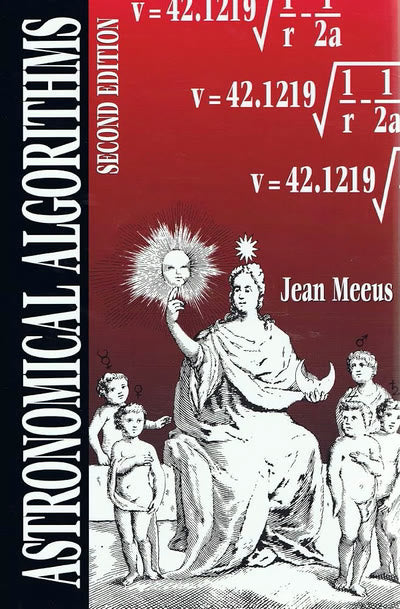
Jean Meeus
Astronomical Algorithms
1991
The computer
Every second, it works out the Moon again.
The code lives on a small computer, a circuit board made for MOON. It calculates how much of the Moon is lit, which way the light is facing, and whether it is above your horizon.

The light
LEDs draw it behind the stone.
Each LED is controlled on its own. The app sends the time and the location once; from then on, everything happens inside MOON. The alabaster scatters the light into one soft Moon.
The alabaster
The LED panel
The computer
All of it goes into the piece.
The LEDs, the computer and its maths, behind the stone.
Layer by layer, it closes.
Assembled by hand in our Lisbon atelier.
Shown: MOON Ninety. Every MOON is built the same way, at its own size.
So, how does the Moon behave?
Is the Moon only out at night?
No.
The Moon is above the horizon about 50 % of the time during the day, and about 50 % of the time during the night.
Let’s start with the basics.
It always shows us the same face
The same side, always
It turns once on itself in the time it takes to go round us, so the same side always faces us.
It only rocks a little, as you can see.
But then why does it have phases?
We are looking at a ball of rock from the side.

The Sun always lights half of the Moon, the half facing it. What changes is how much of that lit half we can see from Earth.
When the Moon is furthest from the Sun, we look straight at its lit half: a full Moon. When it passes between us and the Sun, the lit half faces away and we see almost nothing: a new Moon. Every night in between shows a little more, or a little less, and from one new Moon to the next takes 29½ days.
Why does the Moon rise later every day?
The Moon rises about 50 minutes later each day.
The Moon rises and sets for the same reason the Sun does: the Earth spins once every 24 hours.
If the Moon stood still in the sky, it would rise at the same time every day.
It doesn’t, because it is slowly circling the Earth, one full cycle in 29.5 days. Each day the Moon is a bit further along its path, so the Earth has to turn a little longer to make it rise over the horizon. On average, that means moonrise is about fifty minutes later than the night before.
So some days it rises in the middle of the day.
Does everyone see the Moon the same way?
Same Moon. Different view.


Yes, but not at the same angle.
At the same moment, everyone on Earth sees the same phase. But we stand on different parts of a round planet.
From Antwerp, the Moon can appear upright. Near the equator, it can appear almost on its side. In the Southern Hemisphere, it can appear tilted the other way.
Even from one place, it tilts
Through the night, and through the year.
The lit side of the Moon always points towards the Sun. As the Earth turns, the Sun moves round below the horizon, so through the night the Moon seems to tip over: rising, it leans one way; setting, the other.
And with the seasons.
Because the Earth is tilted, the paths of the Sun and the Moon meet the horizon at different angles through the year. After sunset in March the path stands steep: a young crescent stands high, its lit side turned down towards the Sun. In September it lies low: the same crescent sits just above the horizon, lit from the side.
And this is what MOON follows.
The phase. The angle. The position in the sky. The time it rises and sets.

Not an image of the Moon. The Moon itself, calculated for your location.
Find your MOON →